

Thank god for industry nights, because I have never been so excited to see a show. Thankfully, despite an overzealous tech week eating up my free time, I was finally able to catch the latest project from [producingbody], spaceman. Written by Leegrid Stevens and directed by Eric Slater, this production pushes the medium of live theater in fun and exciting ways, and I couldn’t recommend it more.
This review is going to contain some pretty major spoilers, so I highly recommend you grab a ticket and see the show for yourself before you proceed!
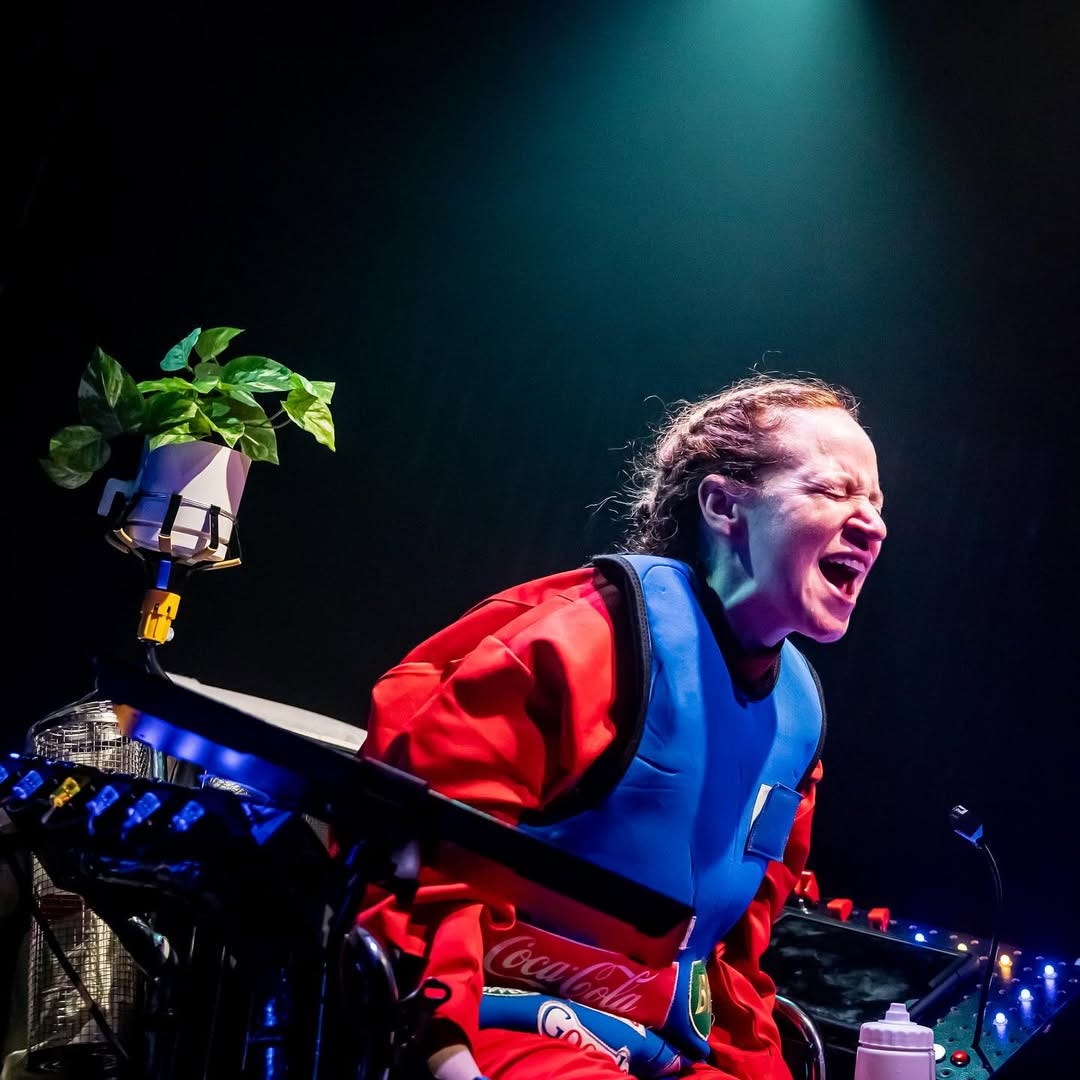
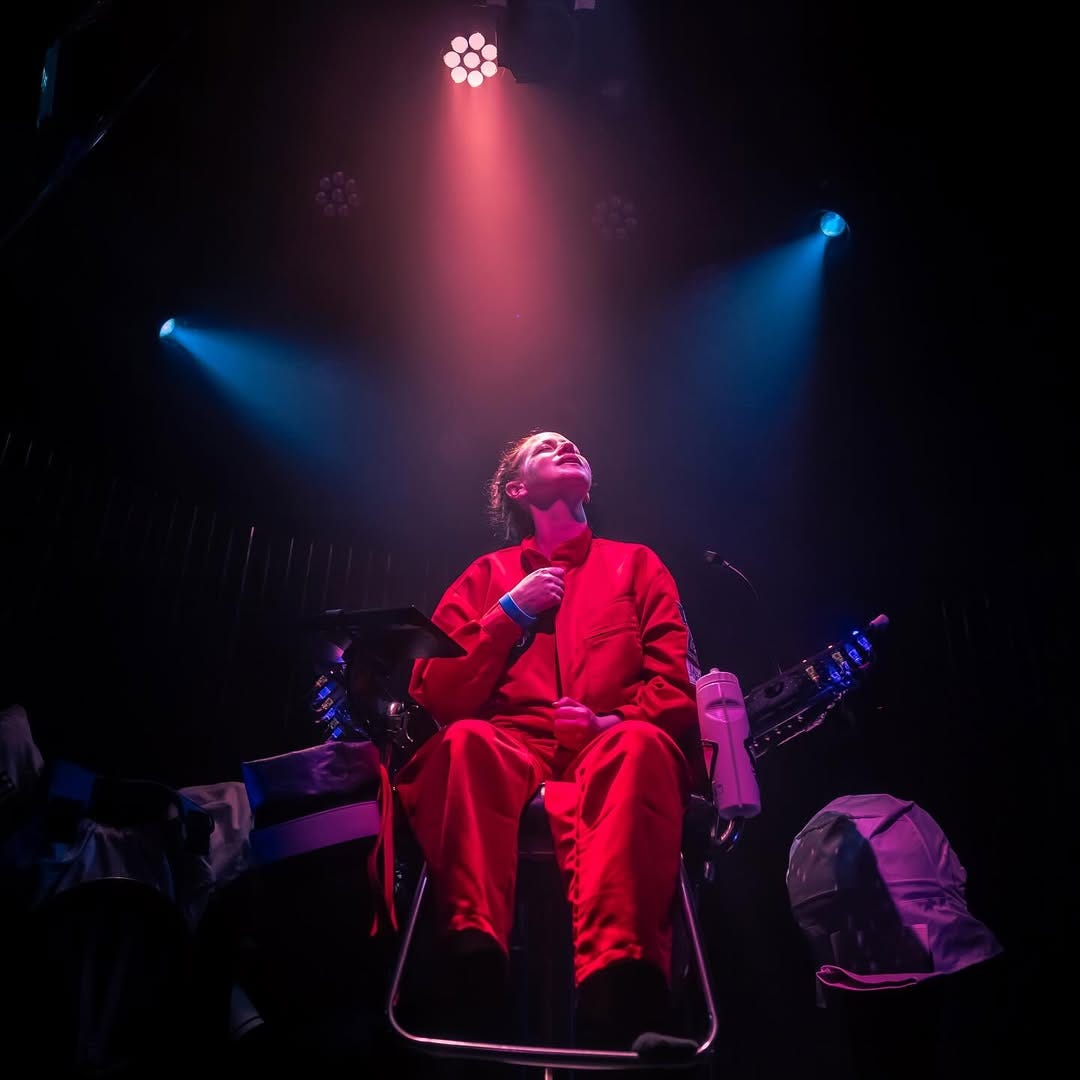
As a lover of all things sci-fi, this show absolutely hit the nail on the head for me, right from the moment I walked into the theater. A soft haze hung over the room, underscored by a soothing ambiance (kinda like when you’re waiting in line for Space Mountain), and gorgeous god-rays of light shot across the room from three different points in space. The lighting design for this show (Garrett Bell) was incredible all around—I think I counted at least 25 different lights (that’s what happens when you take my phone away before a show, I start counting the light fixtures) all focused at and around a singular set piece: a flight chair on a raised circular dais.
The stage (production design by Taylor Dalton) looks almost like an altar, with various offerings scattered about: a pair of boots, a space helmet, a bright blue vest adorned with corporate logos, and some techy-looking panels with wires and glowing plugs sticking out of them. Then, last but not least, as the show begins, one last figure steps onto the pedestal: a lone astronaut, one brave explorer set to venture into the great unknown. But is she the one being worshipped…or is she a sacrifice?
Ashley Neal is astounding as Molly. A one-person show is not for the weak, and yet Neal seems to effortlessly melt into this complex and layered character, delivering a performance that is hilarious, relatable, cathartic, and, in a word…captivating. She blends impeccable comedic timing with moments of heartwrenching vulnerability that portray both sides of long-term isolation, of a woman seemingly slowly losing her marbles. There are aspects of her performance (beyond the heartfelt monologues) that feel incredibly intimate, to a point of near discomfort. There’s something about watching a woman bathe herself with a wet wipe, or erratically sing to herself to keep morale up, or talk to a potted plant that feels almost voyeuristic. With all of these strange idiosyncrasies on full display, Neal portrays a side of Molly that usually only Molly gets to see—the side of ourselves that only comes out when we are truly alone. That’s an incredibly vulnerable thing to put out into the world, but it helps create an instant connection to this delightful character.
Neal accomplishes portraying a different kind of duality, one of a person at the top of her game, split between the job she was hired to do, and the job they actually want her to do. Molly is irrefutably intelligent, despite her team’s efforts to downplay her insights, and is incredibly quick to snap into action during times of crisis, remaining calm and collected even during times of pure panic. She’s a fucking astronaut. But, as messages come in from Houston, we realize that this is the lesser-valued aspect of her job. Her real purpose, the thing that brings in the money from corporate sponsors, is to be a show pony, answering Q&As and cutting promos for the people back home. It’s no small demand, either. It is made plainly clear that the mission is dependent on these sponsors, that her ability to appeal to the masses and feed the algorithm directly impacts how soon she will get to see another human being again. In this light, Molly is perched atop an altar of extraction; she’s a lab rat, a jester, a ritual sacrifice performed for scientific advancement and the almighty algorithm. Through Neal’s performance, we see the strain that kind of attention puts on a person’s psyche.
I know from my own experience working on a one-person show that, though the burden of attention certainly falls on the performer, they are not entirely alone in their endeavor. When there are no other characters onstage, the other members of the production become your scene partners. Stage manager Shannon Golden, sat behind a window like mission control, plays a pivotal role in propelling the story forward, reading Neal’s performance and knowing when to let a moment breathe—or when to cut one short. The sound design by Angela Joy Baldasare brings other characters into the story (albeit on a 10-minute delay) and fills out the world with moments of shock and awe, amidst the silence of space. Puppeteer, Allie Torres, invisible until she’s not, is always ready to, at a moment’s notice, immerse us in a world of weightlessness. She exchanges props with Neal without them once looking at each other, a silent collaboration built on mutual trust and preparation. But even then, it is up to the actor to connect with the audience, and to tell the story through the eyes of their character. In that sense, for the hour and forty minutes spent on that stage, they certainly are alone.
Like many space exploration stories, spaceman is a reflection on isolation—and a reflection on why people seek it out. What kind of person willingly ventures to the outer reaches of mankind’s grasp, farther than anyone has ever strayed from home? Wax on all you want about bravery and scientific advancement and the “greater good” but all humans have a kernel of selfishness within them. What sort of personal gain could possibly lie in such an endeavor? Is Molly running from something?...or does she think she’s chasing something?
spaceman is ultimately a meditation on grief, and our relationship to the divine. We learn early on in the play that Molly is mourning her late wife, Ari. We don’t get to learn much about Ari, other than how she and Molly loved each other very much, that she was also an astronaut who died on a training mission, and that she’s the reason Molly loves football so much. When Molly finished telling the story about how she met Ari—about how Ari pushed her to the ground and kissed her with the force of a god as a football stadium rumbled around them—and then burst into cheers when she learned that her beloved Texans had won the Super Bowl (“Did you hear, Ari? Texans won!”), I fully wept. We weren’t even a third of the way through the play yet.
As Molly drifts alone in what she describes as a graveyard of “dead gods and faded heroes,” it becomes increasingly clear that she isn’t really all that interested in making that “next great leap” for mankind. That’s not what Mars represents for her. That’s not what the PhDs were about, nor the “battery of physical, emotional and intellectual exams” she had to endure in order to get to this point. This mission, to colonize the red planet, was originally Ari’s. She died in pursuit of it. Molly isn’t drifting in space for the betterment of mankind, or to inflate her own ego—and not even to try to finish what her wife started. She’s here to find Ari. Literally or figuratively, rationally or out of her mind, it doesn’t really matter. Molly is hoping to find the love of her life, floating out amongst a bunch of rocks named after ancient deities and mythic heroes, so that she can “knock her teeth out for not checking her tether.”
One of the most deeply affecting moments of the play for me was when the puppeteer removed her mask and spoke…as Ari. It’s a brilliant piece of staging for the “shock value” alone—establish a boundary and then surprise the audience by breaking it—but it becomes all the more potent when you start to realize what it might represent. The idea that Neal’s silent scene partner, Molly’s guiding hand, catching every prop tossed over her shoulder, making them dance with a surreal weightlessness, was her beloved Ari all along. It is not entirely clear when Molly’s world fades from reality to unreality, but what we do know is that she finally found what she was looking for. She leaps from the dais, a pedestaled altar to scientific extraction and revenue-generating algorithms, and into the arms of her lover and protector. Cut off from all communication to home, she has finally reached her Mars. Her God.
It’s a bit serendipitous that I ended up seeing a show about grief that night. Just that morning, I almost cried on my train to work because I suddenly started thinking about my childhood dog, who passed away some years ago. It’s not quite the same as losing a life partner, but I really loved that dog. She was my closest companion growing up—she had seen me at my worst and loved me all the same. Her name was Stormy, after the white stripe that ran down her back as a puppy, which vaguely resembled a lightning bolt. It was raining on the day we had to put her down, and as I came off the highway and drove into my hometown, I shit you not, I looked ahead of me and a great big lightning bolt streaked across the sky. I’m not a particularly spiritual person but I’ll be damned if that didn’t bring me some comfort when I held Stormy in my arms as she slowly drifted off into her eternal sleep.
Do I believe in the afterlife? I don’t know. I’m not sure that will ever be something we get to know. What I do believe is the thing that Molly says at the end of spaceman, as wonderful, beaming motes of light are swirling about her: “There is life everywhere. There is almost no room for it all. There is no emptiness. Life is everywhere.” Whether I “truly” believe it or not, it doesn’t change the fact that, whenever it storms, I choose to believe that it’s my beloved Stormy watching over me, always present, always there to comfort me when times are hard. And if that isn’t closeness to God…then why even bother?
If you’re reading this upon release, then you only have THREE more chances to be dazzled by Ashley Neal in this wonderful piece of independent theatre. [producingbody]’s production of spaceman is open for one more weekend at The Edge Off Broadway, so buy a ticket while you still can!