

This review contains spoilers for the incredible twists and turns of this thrilling escapade, and so I HIGHLY recommend getting out to see the show first, if you get the chance.
I went to see this show on a whim, because I unexpectedly had the evening off from work and Bramble just happened to be having an industry night. I got there early, hopped on the waitlist, and was fortunate enough to grab a ticket for myself—and thank god for that, because this would have been an absolute shame to miss out on. Black Bear Island, written by Chicago playwright, Karissa Murrell Myers, and directed by Jonathan Berry, is marketed as a “gothic, magical realistic thriller” and it is absolutely one of the most thrilling things I’ve seen in a while, across all mediums.
The show starts incredibly dramatically, with a bright flash of white—a bolt of lighting, a flashbulb, a flashback?—that triggers a blackout as the music of Dee Etti-Williams’ impeccable sound design swells in a spooky, suspenseful overture that immediately lets you know that there is a mystery afoot. This music and lighting (by Henry Toohey) are a big part of what makes this show so riveting and immersive. Williams’ strikes a perfect balance between dark, gritty, and dramatic sound design that will send chills up your spine, and slightly campier choices with a bit more of a whimsical feel, reminiscent of the gothic shades of something like Goosebumps.
Meanwhile, Toohey’s lighting design perfectly highlights exactly what the audience needs to see, reigning in the chaos of the story just a little bit. It perfectly compliments Delena Bradley’s scenic design, which is a lush and overgrown bit of forest that feels like it was cut out of the wilderness and placed right into The Beatrice. Likewise, the main setpiece, a sliver of a small a-frame cabin, feels incredibly homey, with a musty couch I could practically smell, and all the exact sorts of assorted knick knacks and kitschy accoutrements you’d expect to see in a rustic hut in the woods. This is the world our characters live in—and one that they embody to the fullest.
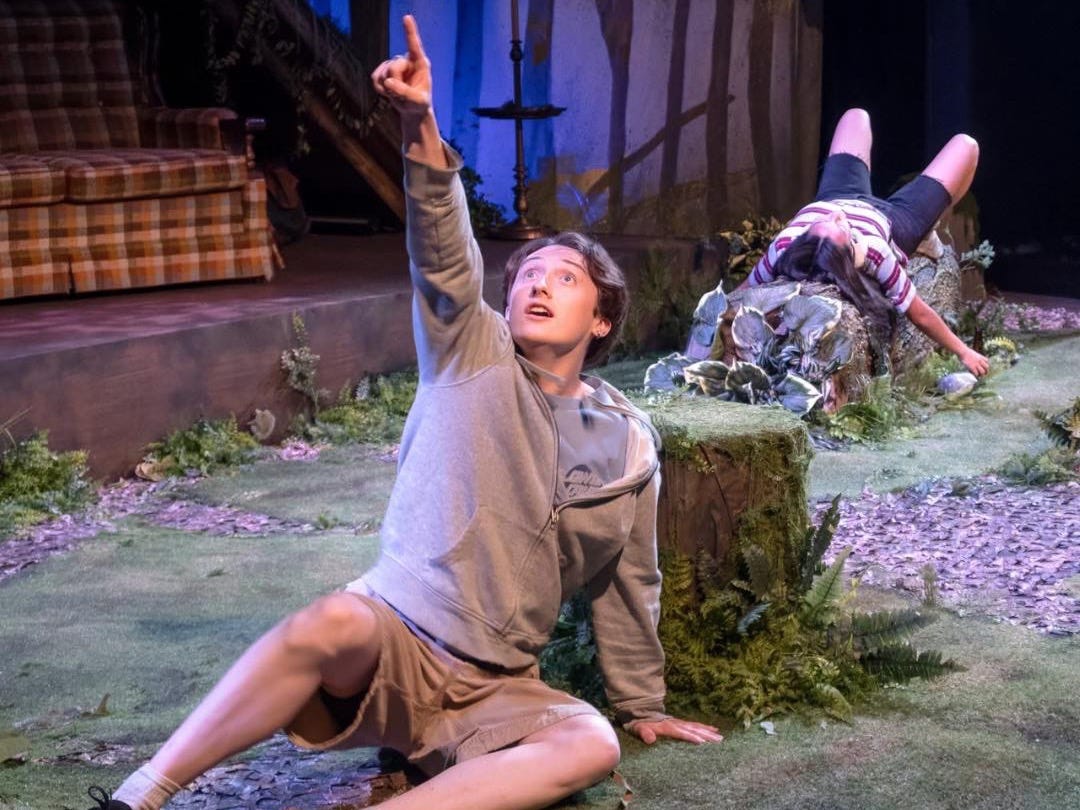
First and foremost, hats off to Berry for putting on a masterclass in staging. The actors are constantly making full use of the space, switching places, twirling around each other, and hopping up on logs; each beat of a scene creates an entirely new picture. It’s one thing to stage complex movement and fight choreography on a wide open flat, but to do it on a realistically-rendered forest floor is another thing altogether. When I first walked in and saw the set, I wondered if they had had problems with the actors trampling the lush greenery, noticing that the entire stage looked like a tripping hazard—and it was! These actors were constantly tripping and tumbling around and, after a while, it became hard to tell if and when they were doing it on purpose or not, which was wildly fun to watch. Major props to the entire cast.
The brilliance of this staging is especially prevalent in the scenes that feature the trio of: young Amitra (Noelle Oh), Warren (Thomas B. Tran), and his brother, Finn (Jesse James Hoover). This trio was brilliantly entertaining during their entire time onstage together. Tran does an incredible job of playing the responsible straight man of the scene, while allowing for a more sinister edge to his character to materialize as the show goes on. Hoover has the least lines of them all, but effortlessly won the audience over with his delightfully dopey cadence and laser-focused delivery. But it was Noelle Oh, playing two zany characters connected across time, that won me over the most. Oh’s movement work was par-to-none as she made the stage into her own personal playground, infusing every scene they were in with a relentless energy and momentum. Despite playing a character that seemingly tries to repress all emotion, they manage to make Amitra incredibly endearing and wildly sympathetic, and she and Tran’s portrayal of a young, tentative couple falling in love pulled at the heartstrings of everyone in the audience—making the story’s twists and turns all the more heartbreaking. Which brings us to the present.
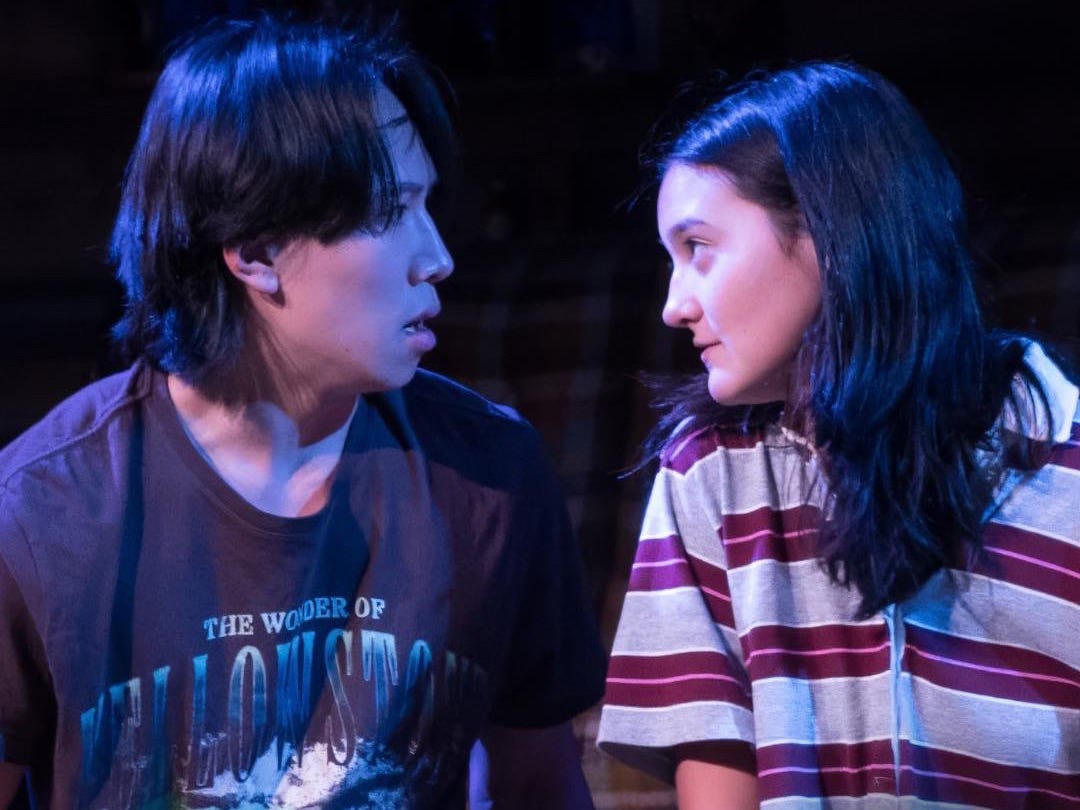
The captivating Carolyn Hu Bradbury plays a version of Amitra that is more mature and self assured, but no less repressed than her younger counterpart, hiding a dark struggle that begins to come to light as the facade starts to crack over the course of her time on the island. Countered by a nosy neighbor who has an opinion about everything (Suzy Krueckeberg), a young girl reminiscent of her past self (Noelle Oh), and the smug echo of her deceased young lover, a charming asshole who only seems to exist in her own mind (Chris Acevedo), Amitra’s version of reality is challenged at every turn, and Bradbury portrays this struggle to a T. Her version of Amitra is assaulted with a horrifying kaleidoscope of fractured, bloody memories and, rather than facing them down stoically like “good heroes” are meant to, we can see how scared she is—and we can see how she stands and faces that fear anyway. That’s a powerful thing to behold.
That fracturing of memories, and that confusing and disorienting miasma of different characters interacting across time and reality, as written in the script, is an incredibly challenging thing to capture onstage. This show devolves into a degree of controlled chaos that was exhilarating to experience. The show creates a set of rules for how the flashbacks work and, one by one, it breaks them. As characters begin to speak to one another and switch places, the rules of reality bend in incomprehensible ways as the tempo of the show picks up, entrances and exits flying by as lights flash across the stage and the music swells and another piece of the puzzle is revealed—a bearskin in a box, papers falling from the ceiling (I don’t know if that was intended as a jumpscare, but it got me), and the realization that the dead “Warren” wasn’t Warren after all and that there is somebody still out there, watching from the undergrowth.
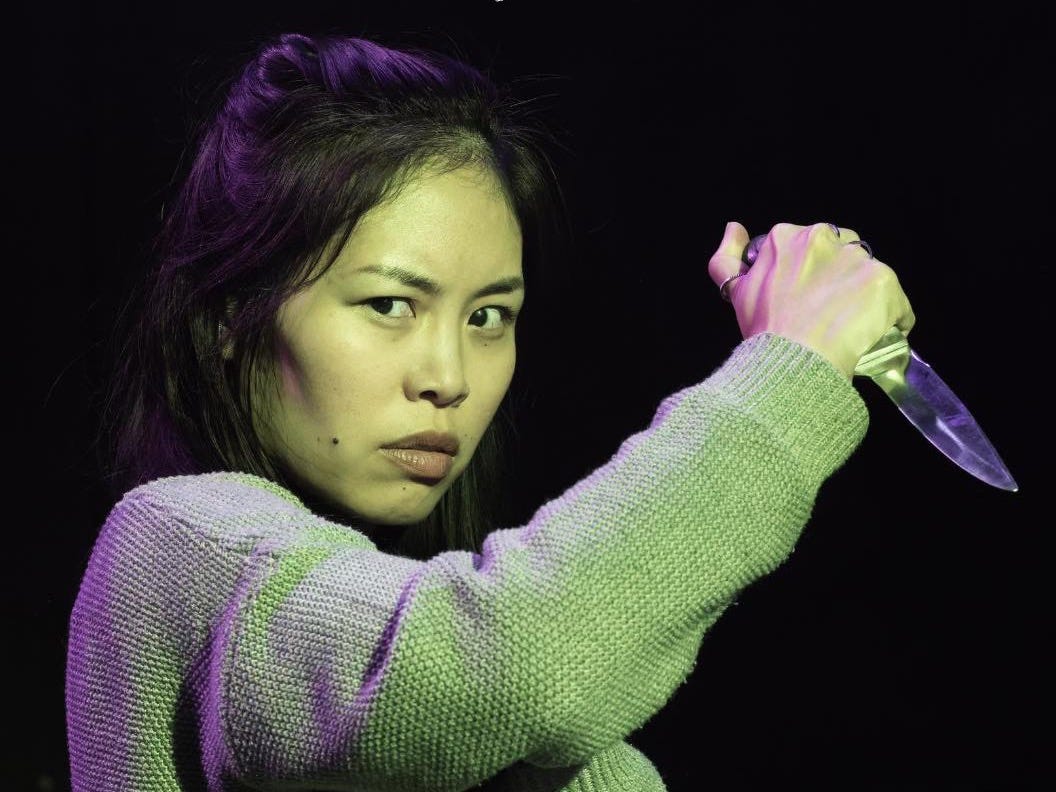
But none of that is what made this play such a viscerally terrifying experience. At the end of the day, it doesn’t matter what was “real” or not. The muddying of reality within the context of a story can be narratively interesting, it can be exciting and mysterious, and it can be a thrilling and suspenseful mind fuck, but there will always be a level of detachment there. Because it’s just a story—none of it’s real. But what is real is the depth and depravity of male entitlement, and the unspeakable violence that follows in its wake. When David Stobbe re-enters as the modern day Warren, the broken, deranged man that has dedicated his life to a women who never consented to it, building her a cabin and stalking her across the globe, the stakes couldn’t be more unreal, but the horror itself felt more real than ever.
The narrative of Amitra, Warren, and their twisted relationship is a fabrication of a playwright, but it’s a fabrication based on a true story—on thousands of true stories. Anyone with even a cursory knowledge of true crime has heard this story before. I personally know several women who have been stalked by men who felt that they were owed affection and attention by the object of their desires. Warren’s obsessive “devotion” and possessive disposition towards a woman who only exists in his own delusions, as an object to be won, projected onto a living, breathing woman named Amitra is something that happens all the time.
Seeing that depravity played out on stage, portrayed by real people standing mere feet away from me was the most horrifying aspect of this performance. Watching Warren’s face shift as he started to become agitated when Amitra refused to prostrate at his feet with gratitude and apologetic deference in response to his so-called benevolence—and then the predictable outburst of violence that followed...that’s what made my skin crawl. That’s what had me looking over my shoulder as I walked home that night.
Just earlier today, I was talking with one of my friends about our frustrations with the media circus surrounding the Cornell 7. Not frustrated that everyone’s talking about it, but frustrated that they’re just now talking about it, and that they’re treating it like it’s something novel when in actuality it’s not. Stories like that, stories like Black Bear Island, happen every day to women all around the world. The thing that is scary about this play—the thing that is real—is the way it puts on full display the dark, twisted, and dangerous rot that lies at the heart of a society built entirely around the desires of men. By the end of this play, you kinda wish it actually was a bear all along.
This show ended up being one of my favorites that I’ve seen all year, and I can’t recommend it enough. If you’re reading this upon release, you still have time to catch their closing weekend, so head on out to Bramble Arts Loft and get ready for the most stressful 90 minutes of your life!